OCCASION
Dr. Marie Enders
UniGR Visiting Professor 2025/26
Chair of Architecture – Theorie – History (ATG)
Department of Architecture (fatuk)
University of Kaiserslautern-Landau (RPTU)
Prof. Dr. Adria Daraban
Cultures of Assembly (COA)
Rue du Brill, 4041 Esch-sur-Alzette, Luxemburg
Research Unit at
Chair of the City of Esch
Department of Geography and Spatial Planning
Faculty of Humanities, Social and Educational Sciences (FHSE), University of Luxembourg, Campus Belval, Luxembourg
Prof. Dr. Markus Miessen
University of the Greater Region – UniGR a.s.b.l.
Cité des Sciences Belval
Maison du Savoir 2, place de l’Université
4365 Esch-sur-Alzette
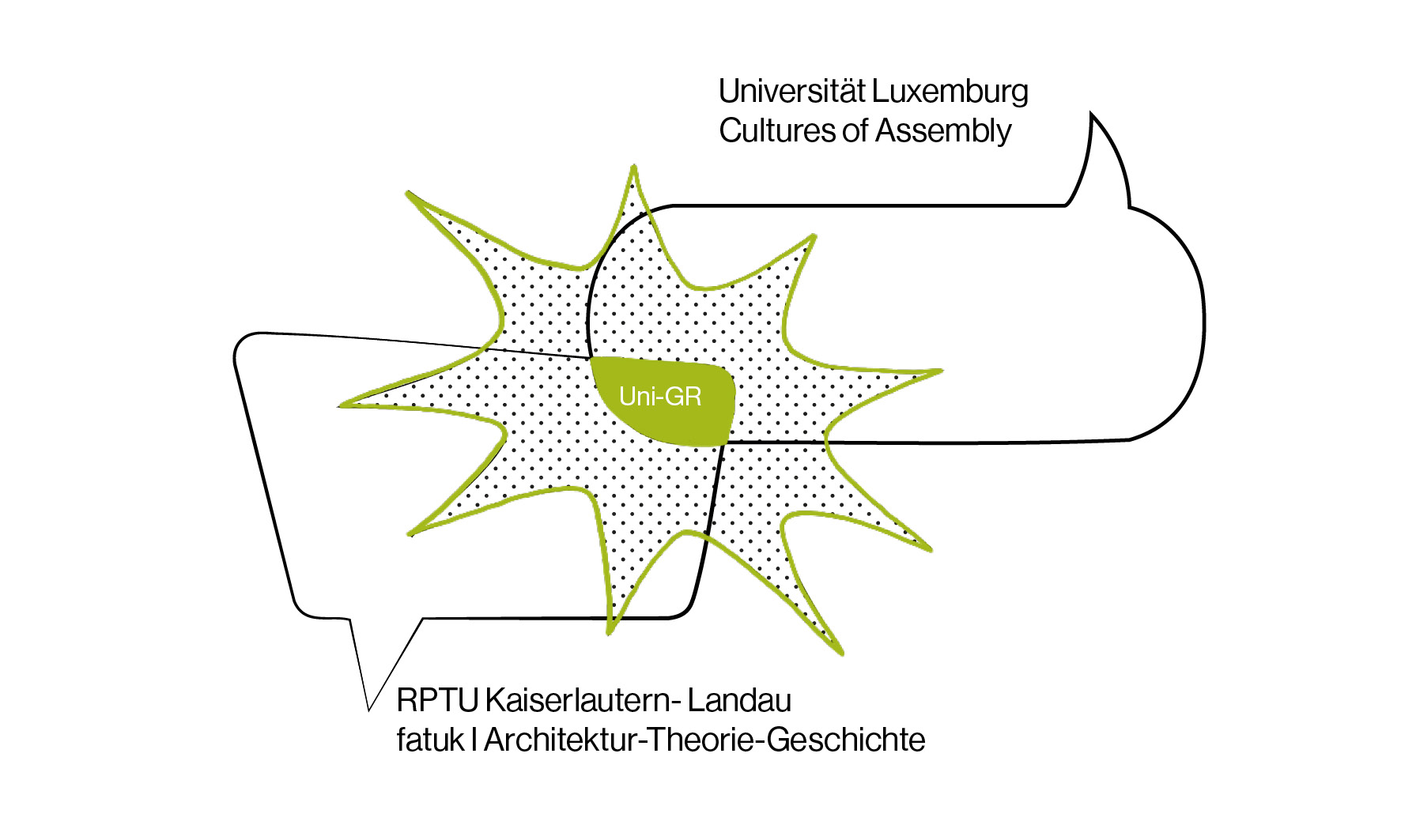
Fragmented Cities, Fragmented Societies
Cities undergoing structural change, particularly in a post-industrial context like Kaiserslautern or Esch, are characterized by challenges such as vacant buildings, social fragmentation, and a shift in urban identity. Especially in 2025, when Kaiserslautern makes headlines not because of its nationally known university, but because of its high AfD voting rates, the need to strengthen profound social cohesion becomes apparent. The transformation process shaping the region requires new forms of urban development that take into account both material and immaterial dimensions. Rainald Manthe aptly summarizes the need for action in his book‘s title, leading to the lack of social cohesion: ‘Demokratie fehlt Begegnung.’
Prof. Dr. Adria Daraban, Professor of Architecture-Theory-History (ATG) at RPTU Kaiserslautern (Heimatinstitut), attributes a ‘productive indeterminacy’ to the built environment, in which the potential for the creation of places of encounter lies dormant. However, it is only through conception and tools of availability that a vacant space – occupied by an existing socio-cultural scene – can become a place of encounter.
Antinomies of the Everyday
Similar to understanding material vacancies as ‘productive indeterminacies’, immaterial phenomena such as superimpositions and supposed irritations can also be understood as ‘productive inconsistencies’. These synergies between material and immaterial dimensions, possibility and supposed contradiction, open up new and resource-saving potentials, especially in times of social change. The postdoctoral project of Dr. Marie Enders, ‘Antinomies of the Everyday’, examines these antinomies as productive areas of tension for urban renewal. Unclear uses of space and intangible vacancies are to be examined for their function as catalysts for resilient urban development processes. The project links to her doctoral thesis at the intersection of urban research and cultural anthropology, in which Enders examines the spatialization of intangible cultural heritage and the venues of everyday culture. In her current research, Enders is exploring these questions at the intersection of intangible space production and social cohesion.
Knowing your Neighbour
An example of a similar approach is provided by the Research Unit ‘Cultures of Assembly’ (COA) (Prof. Dr. Markus Miessen/César Reyes Nájera; guest institute) in Esch/Alzette. Under the direction of Prof. Dr. Markus Miessen, forms of citizens‘ assemblies and decentralized decision-making structures are being researched with a focus on spatial justice. The project links a digital platform with an open neighborhood agency, ‘The Esch Clinics’, in Esch-sur-Alzette. The methods include contextual explorations, immersive research to learn from local citizens and their diverse experiences, and the organization of agonistic assemblies to create productive friction between relevant interest groups. The goal is to develop integrative political recommendations for urban renewal in collaboration with local stakeholders and to strengthen the role of underrepresented groups in urban transformation processes. The COA is thus considered a model project for how universities can be more integrated into the transformation process of urban development. Among other things, with one of their principles, ‘Knowing your Neighbour’, Miessen and Reyes Nájera have made a first contribution to the question of how to create missing spaces of encounter in times of transformational and structural change. But how could collaboration among experts within the University of the Greater Region (UniGR) contribute to this? As part of the guest professorship, Marie Enders is aiming for to contribute to answering this question by linking the research approaches of COA and ATG, as well as to her postdoc project. Her central research question within the framework of the visiting professorship would therefore be:
- What influence do the ‘antinomies of the everyday’ have as productive areas of tension for urban renewal in use on a local, regional, or international scale?
- How can the scaled-up ‘Knowing-your-Neighbour’ principle be applied to the University of the Greater Region to promote cross-border cooperation and create decentralized meeting places that strengthen social cohesion at all levels?
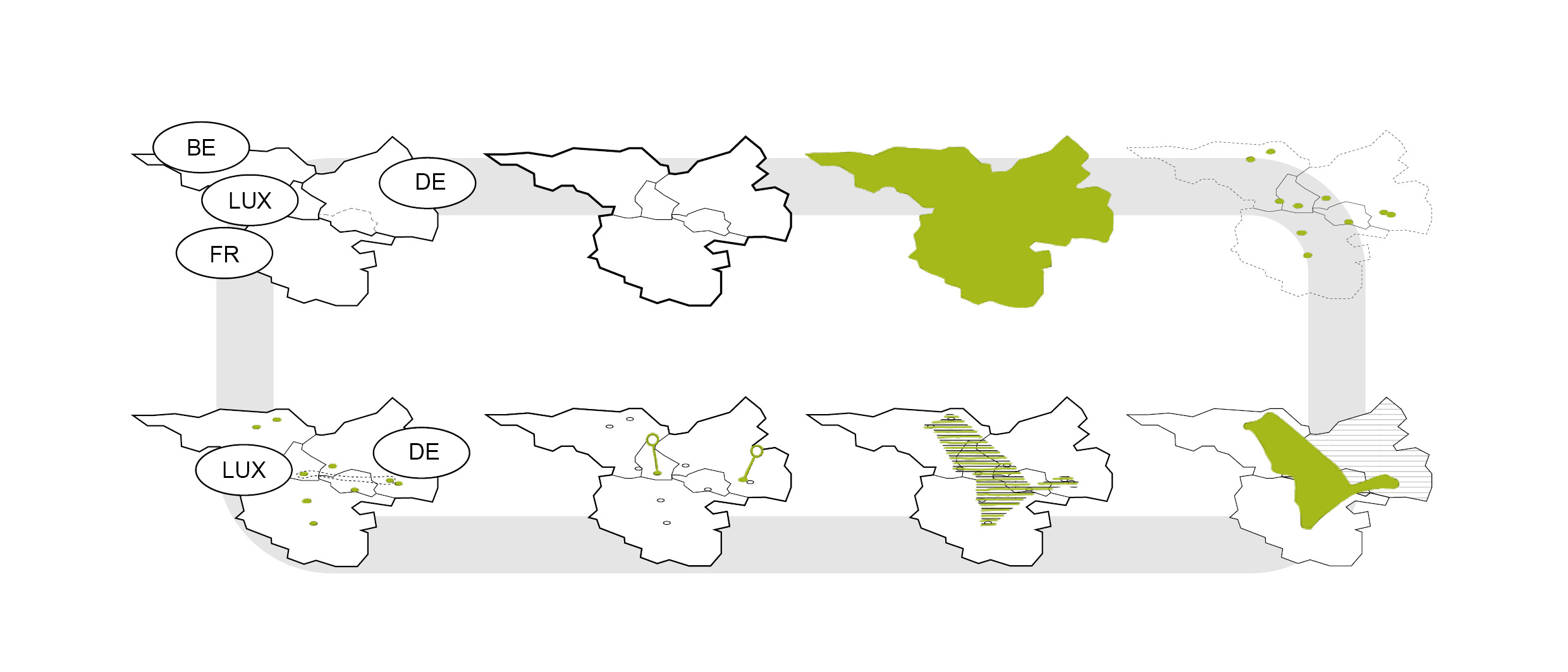
Crossing borders –the ‘Knowing Your Neighbour’ principle scaled up
The creation of so-called ‘neighborhood agencies’ goes beyond just getting to know the neighbor next door. Rather, the focus is on the university‘s role as a moderator in the sense of Cultural Brokering. Analysis and communication of local phenomena are used to create databases for the structured support and design of transformative processes. This principle, which works on a local scale, should now also be used for cross-border cooperation with neighboring countries, cities, and universities in the greater region to capture the productive influence of antinomies on everyday encounters. As part of the UniGR guest professorship, both the practical experience of the Research Unit COA under the direction of Prof. Dr. Markus Miessen (University of Luxembourg) and the theoretical perspective of the Heimatinstitut ATG (Prof. Dr. Adria Daraban, RPTU Kaiserslautern) are of central importance for the productive activation of vacant space. Both professors are working on thematically related questions, although there has not been any direct collaboration between the institutes so far. This opens up the possibility of developing new perspectives and approaches beyond potential cooperation, which can strengthen the exchange between the two institutions and their respective areas of expertise. The University of Luxembourg also offers an institutional environment that productively combines interdisciplinary approaches in architecture, urban research, and social sciences. Through initiatives like COA, which are firmly embedded in university structures, the university demonstrates its special potential to combine practical research with societal impact. This institutional openness is particularly valuable for the planned project.
University and City along with digital networking in the region
While this connection has already been established in Luxembourg, similar efforts by the ATG department of RPTU Kaiserslautern are in the development phase. The ATG field of study is also concerned in Kaiserslautern with the question of space availability and how vacancy and existing socio-cultural programs can be combined with each other as potential space utilization in order to create new productive moments. The digital space is also considered in this context. Rainald Manthe emphasizes, in his considerations on the use of digital space, in addition to possible alienation effects, also the potential to promote location-independent social participation – he speaks of ‘digital support of decision-making processes.’ The approach to the use of digital formats to be developed jointly in the project makes sense, especially in light of the limited resources of the mobility scholarship, while the cooperation has medium-term to long-term aspirations. Thus, on the one hand, decentralized local encounters are to be created. At the same time, the digital space opens up the opportunity to exchange and make tried-and-tested methods and tools accessible. This enables other UniGR university locations and faculties to connect and ensures a sustainable impact of the mobility exchange. ‘Here, technology does not replace encounter; rather, it amplifies its potential.’
Encounter as a method –
formats, tools, and digital synergies
The planned project aims to combine existing approaches and evaluate this exchange. The goal is to identify and analyze productive areas of tension for urban renewal, to network existing initiatives and projects in the greater region, and to create new places of encounter and negotiation that serve the cohesion of society as a whole. Digital tools will enable agile collaboration. For the planned project, I would like to initiate a cooperation between the University of Luxembourg and RPTU Kaiserslautern, which allows for exchange on the creation of meeting places for better networking, reflection on one‘s own role, and positioning on the use of digital platforms. The central elements of the project are:
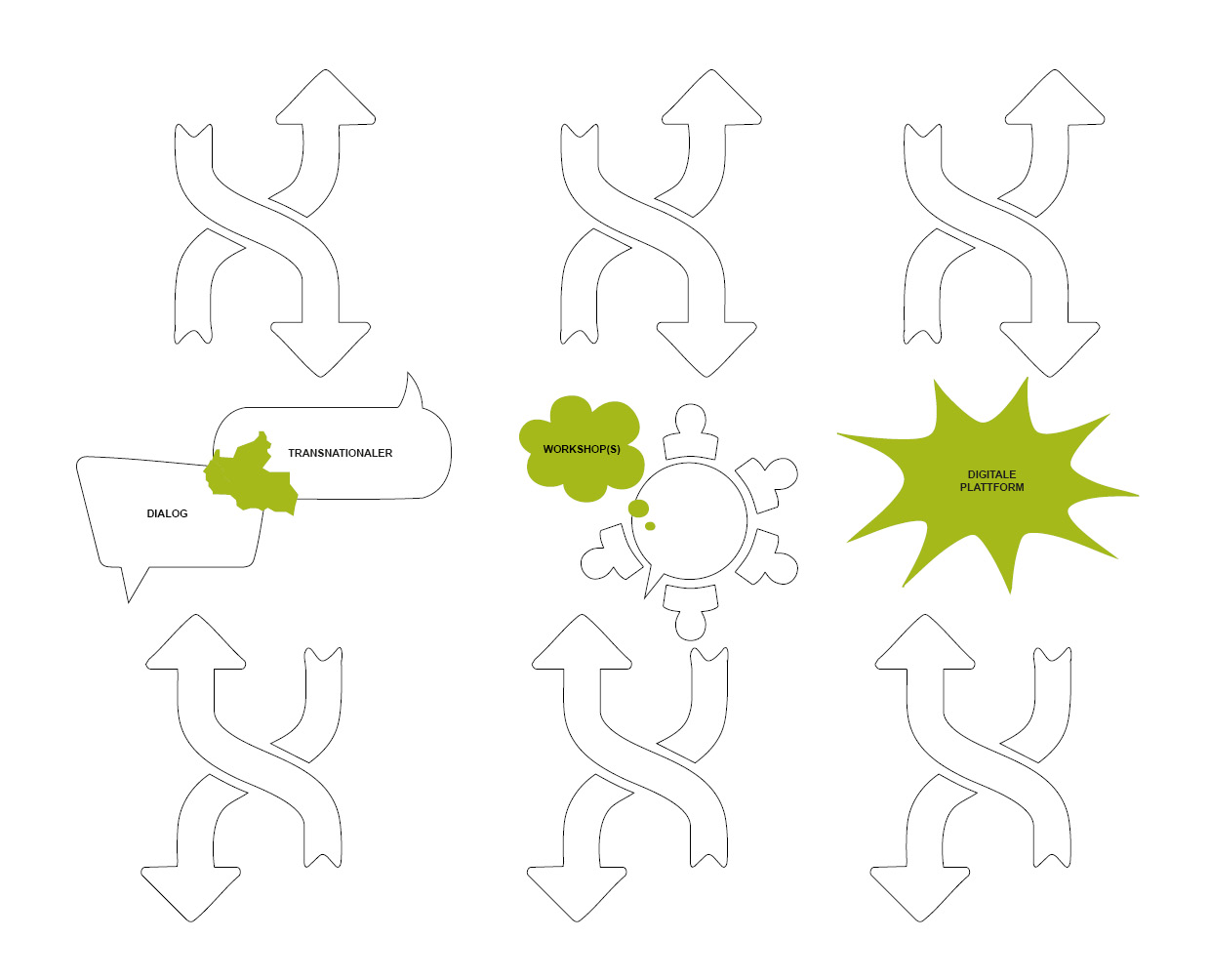
- A transnational dialogue between academics and practitioners from both university locations on methodological tools for transferring tools to create meeting places in post-industrial cities.
- Workshops that enable the exchange of perspectives and the development of shared tools to strengthen social cohesion.
- Digital follow-up formats that enable the exchange of experiences across regional boundaries and make tools visible that can be tested in further emerging meeting spaces. There should be a digital platform for transparent visibility of the exchange and follow-up meetings. The other UniGR locations and professorships are also to be involved here.
Integrated Teaching Formats
A joint course forms the integral framework in which the three elements of the guest professorship – transnational dialogue, multilateral workshops, and digital follow-up formats – are systematically interlinked. By embedding the course into the curricula of the participating institutes, direct transnational exchange is guaranteed. During the course of the project, tools and methods will be developed that will work towards answering the central question. These are reflected and further developed in the workshops at the UniGR locations. The workshops will also be reflected in a broader circle with the professional public and shared with civil society in the form of an exhibition at the end of the period. The goal is to establish a digital platform for sustainable, cross-border collaboration beyond the project period.
Long-Term Vision – UniGR Network as a Platform
Another step in the project is to develop a digital platform for the continuous exchange and application of results at the local, regional, and international levels. This platform could be expanded through the collaboration of all eight UniGR locations as well as departments of architecture and urban planning to ensure the visibility and transferability of the developed concepts. Through the visiting professorship, Marie Enders aims to further advance the link between scientific theory and practical urban development and to establish UniGR as a catalyst for transnational cooperation in the field of urban development and social cohesion. The creation of places of encounter and dialogue is a significant contribution to the transformation of post-industrial cities. The proposed project aims, through the UniGR Visiting Professorship, to enable Marie Enders to build a bridge between academic research and practice-oriented urban development, while offering new, innovative models for structural transformation.
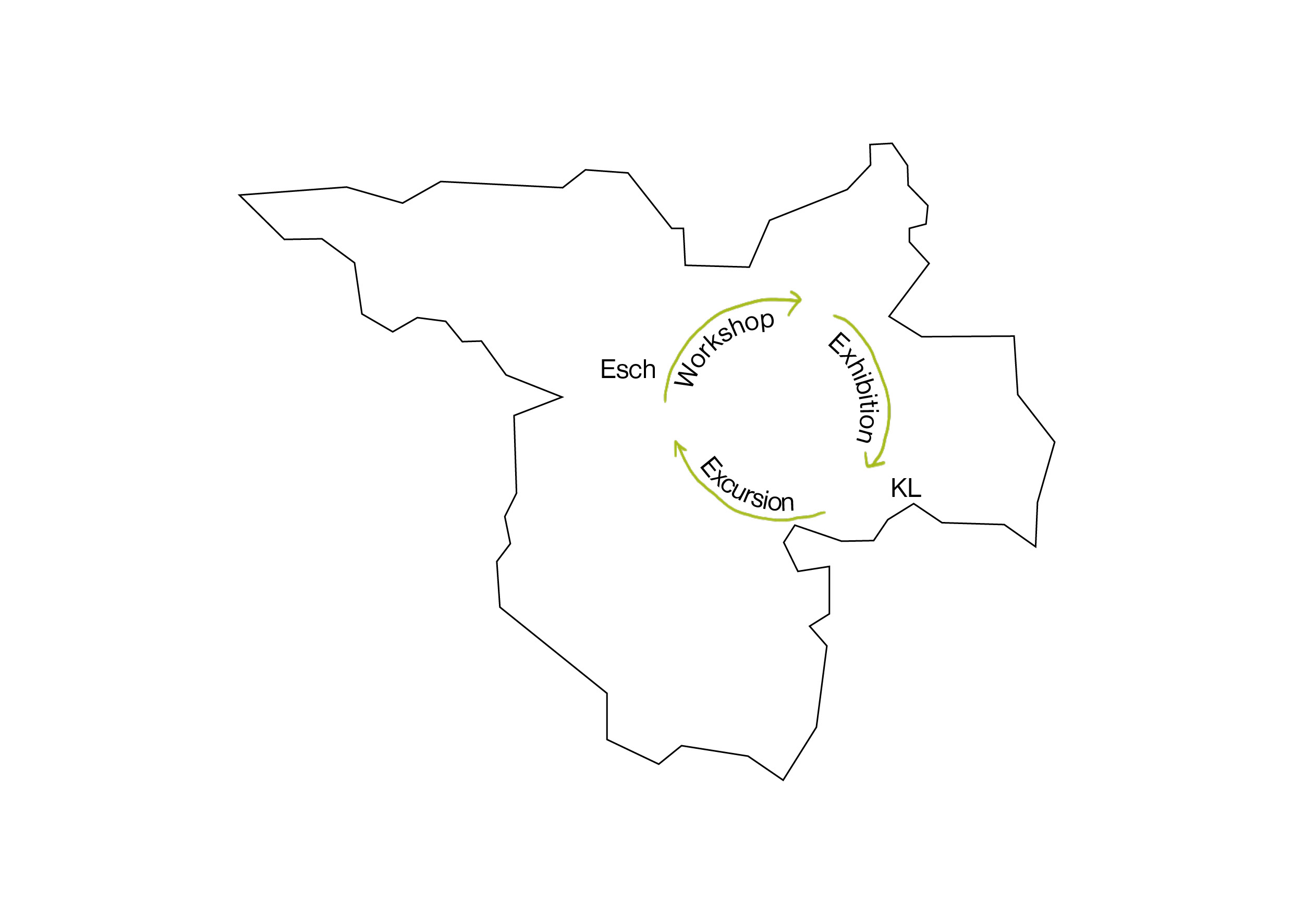
The Project | Three Parts:
Workshops, Excursion, Exhibition
The project ‘Encounters in the Greater Region’ examines places of democratic exchange and social cohesion in a transnational context. The focus of the course is on developing tools for making immaterial urban resources visible and on strategies for reactivating vacant spaces. At the same time, the aim—building on the Uni-GR Visiting Professorship—is the medium-term development of a shared digital platform. This platform is intended to serve as a public toolbox that makes innovative instruments of urban development accessible locally, regionally, and internationally.
In cooperation with more than 25 students from the University of Luxembourg (Research Unit Cultures of Assembly, Prof. Dr. Markus Miessen) and the Department of Architecture – Theory – History (Prof. Dr. Adria Daraban) at RPTU Kaiserslautern-Landau, a new teaching format is being developed in the first step, operating at the interface between academic research and practical urban development. The project includes field research, weekly supervision, a joint workshop in Esch-sur-Alzette, an exhibition in Kaiserslautern, as well as inputs and guest critiques from experts. The students take on the challenge of understanding the Greater Region as a polis: They identify and analyze places of encounter and spaces of democratic exchange that strengthen society and subsequently valorize them architecturally. In doing so, they develop and test both tools for capturing immaterial urban practices and instruments for architectural design and spatial strategic development. The complex undertaking follows a phase-based structure with interrelated milestones that combine experimental work, theoretical reflection, and design implementation.
The seminar is structured in three phases, each producing intermediate results. For more details of the phases, see the subpage Outcomes.
The Challenge | Goals and Objectives:
Milestones
- The Greater Region as Polis – Analysis of the region as a ‘productive field of tension for regional valorization’ processes.
- Cross-border Neighborhood – Promoting cooperation within the UniGR (Knowing Your Neighbour).
- Tool Development & Application – Developing and testing participatory, transnational tools to identify and strengthen places of encounter.
- Student Involvement – Integration into transnational tandems: using the example of ‘Klang,’ capturing the
- immaterial resource ‘encounter’ through mapping and game development; later, developing their own tools and strategies for architectural valorization.
- Digital Platform Development – Documentation, networking, and exchange of methods and tools across different scales beyond the project duration.
- Strengthening Democracy – Promoting social cohesion and democratic participation in post-industrial cities through the activation of material and immaterial spaces.
For more information, please see the following reader – available for download: