-
![]()
UNLEARNING HISTORY AND THEORY
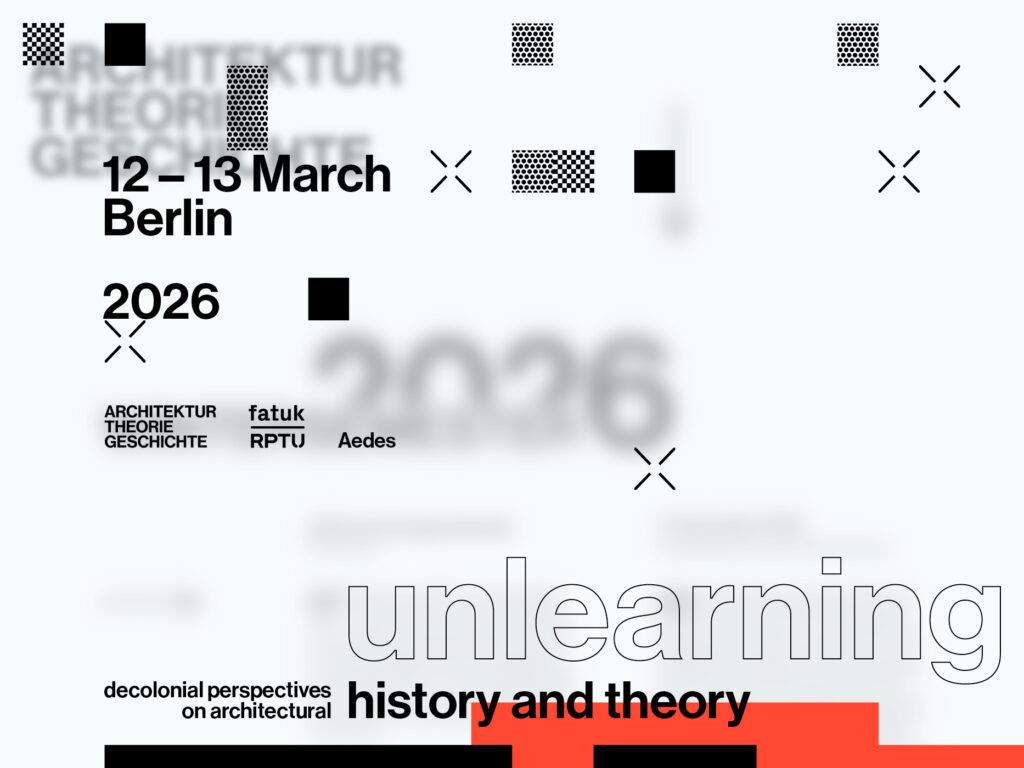
On 12–13 March 2026, the workshop UNLEARNING HISTORY AND THEORY: Decolonial Perspectives on Architectural History and Theory brought together researchers, educators, and practitioners at AEDES in Berlin for two days of workshops, public lectures, and interdisciplinary exchange. Conceived and initiated by Prof. Dr. Adria Daraban and the Architecture–Theory–History Chair, Faculty of Architecture (fatuk), RPTU University Kaiserslautern-Landau, the event explored the ongoing transformation of architectural history and theory through decolonial perspectives.
-
![]()
Workshop UNLEARNING
The workshop UNLEARNING HISTORY AND THEORY engages with architectural history and theory through decolonial perspectives. Conceived as an open and exploratory format, it interrogates colonial power relations, hegemonic structures, inequalities and exclusions in knowledge systems, and encourages critical discussion and collaborative approaches towards more inclusive and diverse educational practices.
-
![]()
TIMETABLE
UNLEARNING HISTORY AND THEORY: Decolonial Perspectives on Architectural History and Theory brings together a two-day workshop and a public lecture series.Thursday begins with a closed working group session focused on contextualisation, narratives, visibility, and historiography. In the afternoon, the public lectures explore the global turn in architecture, building narratives stories, decolonial approaches, institutional critique, and educational practices. On Friday, the workshop continues with new tools and interdisciplinary methods, and a concluding plenary reflection.
-
![]()
PUBLIC LECTURES
The public lecture program of UNLEARNING HISTORY AND THEORY: Decolonial Perspectives on Architectural History and Theory takes place on Thursday, 12 March 2026, from 1:00 to 8:00 p.m ant the AEDES Campus in Berlin. The event brings together contributions by Tom Avermaete, Janina Gosseye, Kenny Cupers, Tatjana Schneider, Anna-Maria Meister, and Ola Uduku. The lectures address the global turn in post-war architectural culture, practices of building and narrating histories, situated perspectives, critiques of architectural education and institutional frameworks, and the design and purpose of educational buildings in Africa.