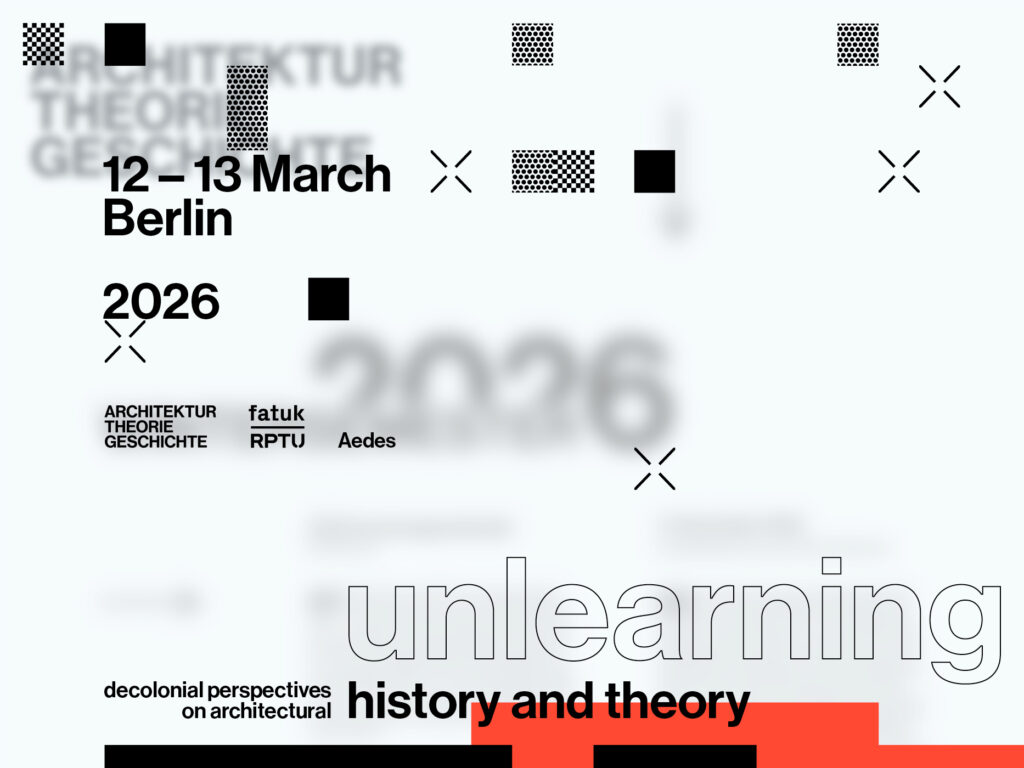
UNLEARNING HISTORY AND THEORY
UNLEARNING HISTORY AND THEORY
Decolonial Perspectives on Architectural History and Theory
Berlin 12–13 March 2026
The workshop UNLEARNING HISTORY AND THEORY engages with architectural history and theory through decolonial perspectives. Conceived as an open and exploratory format, it interrogates colonial power relations, hegemonic structures, inequalities and exclusions in knowledge systems, and encourages critical discussion and collaborative approaches towards more inclusive and diverse educational practices.
The history and theory of architecture are undergoing a fundamental transformation. Historical narratives and theoretical arguments rely on tools and methods used to interpret them. For a long time, these have been shaped by knowledge systems that not only ignored colonial power relations, hegemonic structures, spatial inequalities, and ecological dependencies, but often actively reproduced them. This has had a decisive influence on how architecture is understood and interpreted and has regulated which histories and theories are included or systematically excluded.
It is encouraging to see an increasing focus on social justice in architecture schools, one that centres global relations and explicitly engages with political and social responsibility. There is a growing awareness of the need to include a broader diversity of voices and perspectives and to decolonise architectural education. This shift raises questions about its impact on academic education.
The workshop “UNLEARNING HISTORY AND THEORY: Decolonial Perspectives on Architectural History and Theory” situates these questions within architectural educational institutions, and more specifically within the programmes of history and theory. Its aim is to identify and foster strategies for adopting a pluralistic and inclusive approach to architectural education, with a particular focus on teaching architectural history and theory today.
Reframing the discipline requires disclosing intrinsic aspects of coloniality, racialisation, segregation, and exclusion embedded within established knowledge structures. Reviewing the knowledge techniques and formats of teaching and communication of architectural histories and theories entails renegotiating methodological boundaries, rethinking theoretical assumptions and conventions, and recognising historical absences and presences.
Change in this regard is only possible through cooperation, collective action, and collaborative knowledge-sharing. Rather than rejecting historical knowledge and teaching methods, the workshop encourages critical engagement with them. Its agenda includes interdisciplinary dialogue among architectural history, architectural theory, cultural studies, and political science. Guided by the question “Who tells whose history?”, the workshop will be dynamically structured: keynote speakers, moderators, and participants will swap roles to enable a polyphonic and non-hierarchical exchange.
Alongside the workshop, we are holding in cooperation with Aedes a series of public lectures on Thursday, 12 March, from 1–8 p.m.
Registration for the public lectures: here
Aedes: Christinenstr. 18-19 | 10119 Berlin
The event will take place in English. Admittance is free.
The project was initiated by the Architecture – Theory – History Department at the Faculty of Architecture at RPTU University in Kaiserslautern-Landau. Further information here.